











Real Estate Technical Due Diligence & Building Assessments
Technical Due Diligence for Real Estate Assets
Independent technical clarity before acquisition, investment or financing
Technical Due Diligence, or TDD, is an independent, engineering-led review of a real-estate asset’s physical condition, available technical documentation, observable risks and potential capital expenditure requirements. VALIDX provides Technical Due Diligence and building assessments for residences, premium villas, development plots, hotels, hospitality properties, commercial buildings and other real-estate assets across Greece.
Our objective is to give buyers, investors and professional advisers a clear and evidence-based understanding of the asset before a significant decision is made. Technical Due Diligence complements the legal, notarial, valuation, financial and tax reviews undertaken by the client’s other professional advisers; it does not replace them.
When is Technical Due Diligence required?

Before acquiring a property:
TDD allows the prospective buyer to understand the asset’s actual technical condition, material defects, immediate repair needs and potential future expenditure before completing the transaction.
Before acquiring a plot or development site:
The review may consider available topographical and planning documentation, access, utilities, apparent development constraints and other technical factors that may affect the intended use of the property.
Before redevelopment or conversion
For assets undergoing renovation, change of use, extension or repositioning, TDD helps identify existing-condition risks, infrastructure limitations, outstanding works and likely intervention requirements.
Before financing or refinancing
A technical report may support discussions with lenders, investors or financing advisers by providing an independent assessment of the underlying physical asset. Formal lender reliance is subject to a separately agreed scope, appointment and reliance framework.
Before handover or operational use:
TDD and condition assessments may also be undertaken before practical completion, handover, commissioning, hotel opening or commencement of commercial operation.
During ownership and asset management:
Periodic building-condition assessments and lifecycle CAPEX reviews help owners plan maintenance, refurbishment, compliance actions and future investment.
Our Technical Due Diligence scope
Building fabric and observable structural condition:
Our inspection may consider foundations and structural elements that are visible and accessible, walls, roofs, façades, balconies, terraces, basements, waterproofing, windows, doors and other principal elements of the building fabric. The assessment identifies visible deterioration, cracking, moisture, corrosion, deformation or other indicators that may require repair or further specialist investigation.
Mechanical, electrical and plumbing systems:
The review may include the condition and apparent functionality of: Electrical installations, Water-supply and drainage systems, Heating, ventilation and air-conditioning, Domestic hot-water systems, Fire-detection and fire-protection installations, Lifts and other vertical transportation, Generators, backup power and energy systems, Building-management, security and control systems, Testing, measurements and specialist inspections are performed only where included in the agreed scope.
Technical and planning documentation:
VALIDX reviews the technical documentation made available for the assignment, which may include Building permits and approved plans, Topographical surveys, Architectural, structural and MEP drawings, Energy-performance documentation, Fire-safety records, Inspection and maintenance certificates, Renovation and construction records, Equipment manuals, warranties and test reports
Repair priorities and indicative CAPEX
Findings are classified according to their significance, urgency and potential effect on the investment decision.
Where included in the scope, the report may provide an indicative assessment of:
- Immediate remedial works
- Short- and medium-term repair priorities
- Deferred maintenance
- Upgrade requirements
- Further specialist investigations
- Potential capital expenditure
Detailed bills of quantities, formal cost plans and cost-to-complete assessments require the involvement of an appropriately qualified cost consultant or quantity surveyor.
Asset-specific Technical Due Diligence
Residences and premium villas:
For residential acquisitions, the assessment focuses on the physical condition of the property, visible construction defects, building services, external infrastructure, immediate repair requirements and matters that may affect safe and satisfactory ownership. For complex villas and island estates, the scope may also include independent water, wastewater, energy, pool, access and backup-power systems.
Plots and development land:
For plots and land parcels, the technical review may consider available planning parameters, topographical information, apparent buildability constraints, access, utilities, ground conditions and the infrastructure needed to support the intended development. Formal confirmation of planning rights, land boundaries and legal title is undertaken by the appropriately licensed surveyors, engineers and legal advisers.
Hotels and hospitality assets:
Hotel Technical Due Diligence may extend beyond the building fabric to include: Guestrooms and public areas, Kitchens, laundry and back-of-house facilities, HVAC and domestic hot-water capacity, Pools, spas and water treatment, Fire and life-safety systems, Vertical transportation, Operational infrastructure, Deferred maintenance, FF&E-related technical observations, Opening or operational-readiness matters, Immediate and lifecycle CAPEX. The technical review may support acquisition, refurbishment, repositioning, refinancing or asset-management decisions.
Commercial and income-producing assets:
For commercial, mixed-use or income-producing properties, the assessment may address physical condition, operational infrastructure, statutory inspection status, maintenance exposure, remaining useful life and the technical factors that may affect continued occupation or future investment.
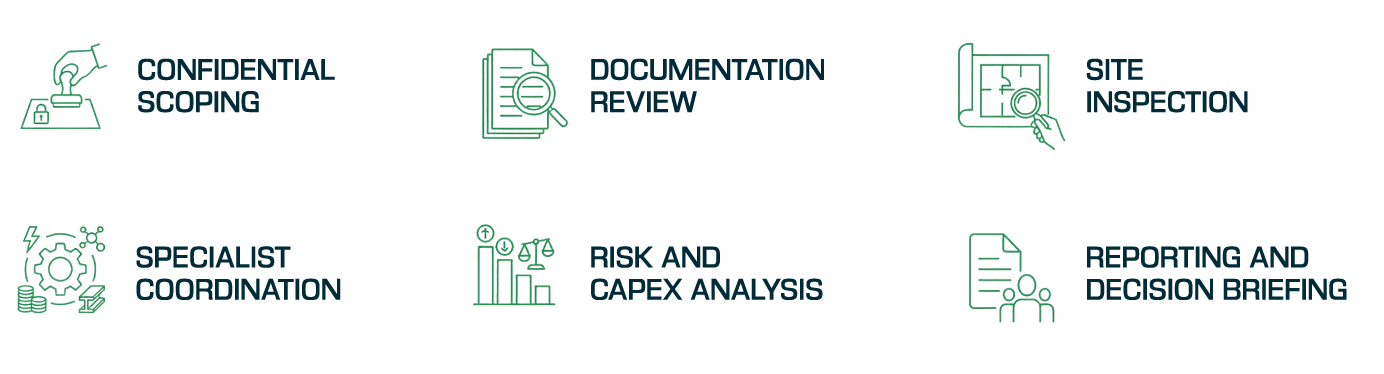
Our Technical Due Diligence process
What does the client receive?
A typical VALIDX Technical Due Diligence report may include:
- Executive summary
- Description of the asset and agreed scope
- Documents reviewed
- Photographic evidence
- Findings organised by technical discipline
- Red–Amber–Green risk classification
- Material-defect and risk register
- Immediate and medium-term action priorities
- Indicative CAPEX observations, where included
- Recommended specialist investigations
- Scope limitations and inaccessible areas
- Executive review call with the client
Reports are prepared in English and structured for international buyers, family offices, investment committees, professional advisers and selected financing discussions.
Why VALIDX?
Independent and evidence-based assessment:
Our conclusions are based on defined scope, documented evidence, structured inspection and transparent reporting.
Recognised conformity-assessment background:
VALIDX holds internationally recognised accreditations under ISO/IEC 17020 and ISO/IEC 17065 for defined inspection and product-conformity assessment activities. Technical Due Diligence is delivered as a specialised technical advisory service unless the appointment expressly identifies an activity falling within an accredited scope.
International EPC and high-risk-sector experience:
Our technical leadership and inspection teams bring international experience from complex EPC, construction, industrial and infrastructure environments involving leading contractors, developers and asset owners.
Multidisciplinary capability:
The assignment can be adapted to residential, hospitality, commercial and development assets and supported by specialist professionals where required.
Coverage across Greece, other Market on the pipeline (Italy, Spain, Cyprus):
VALIDX supports assignments in Athens, Thessaloniki, Crete, mainland Greece and the Greek islands, subject to access, mobilisation and the requirements of each project.
! A clear and responsible scope !
Technical Due Diligence is intended to support informed decision-making. It is not a guarantee that an asset is free from defects, nor does it replace: Legal title due diligence, Notarial review, Formal property valuation, Tax or financial due diligence, Intrusive structural investigation, Geotechnical testing, Detailed design verification, Statutory approvals issued by competent authorities, Any right of reliance by a bank, investor, fund or other third party must be expressly agreed in writing.
A Technical Due Diligence report is an independent assessment of a property’s physical condition, available technical documentation, material risks and likely repair or investment requirements. It helps a buyer or investor understand the technical exposure associated with an acquisition or development decision.
A building inspection primarily examines the observable condition of the property. Technical Due Diligence places those findings within the wider transaction context and may also include documentation review, risk classification, CAPEX observations, specialist coordination and reporting for investors or professional advisers.
No. Ownership, title, encumbrances and contractual matters are reviewed by the client’s lawyer and notary. VALIDX reviews available technical and planning documentation for apparent gaps or inconsistencies and identifies matters requiring formal confirmation.
The report may be disclosed to a financing institution for information, subject to the agreed terms. Formal bank reliance, duty of care or use for loan drawdown decisions requires a separate written agreement and lender-approved scope.
Yes. The scope may include the physical hotel asset, MEP systems, operational infrastructure, deferred maintenance, technical CAPEX, construction progress, commissioning and opening readiness. Hotel-market feasibility, valuation and financial underwriting are provided by the relevant specialist advisers.
Indicative CAPEX observations can be included where sufficient information is available. Detailed cost plans, bills of quantities and formal cost-to-complete assessments require an appropriately qualified cost consultant.
The timetable depends on the size and complexity of the asset, its location, access, the quality of available documentation and the need for specialist investigations. The programme is confirmed after the initial questionnaire and scoping review.
The fee is based on the asset type, size, location, documentation, inspection requirements, reporting depth and intended use of the report. VALIDX issues a fixed proposal after reviewing the preliminary TDD questionnaire.